Darwin, God, and Theology: Some Essential Reads in Historiography
In Richard Dawkins' seminal The Blind Watchmaker, there resides a quote perhaps more known than the book itself: "Although atheism might have been logically tenable before Darwin, Darwin made it possible to be an intellectually fulfilled atheist" (p.10). Such of course is the now-typical assessment of the legacy of Darwin for religion. On the other hand, Darwin historian John Durant quite provocatively states, "The Origin of Species [was] the last great work of Victorian natural theology" (p.16). While the two statements are not, strictly speaking, opposites--given the "secularizing" current in Victorian theology at the time--nonetheless the juxtaposition of these two quotes is quite striking. As Durant himself notes, "faced with so many opinions about the historic relationship between science and religious belief, cautious readers may suspect rather more is at stake than a mere point of intellectual history" (p.12).
As it turns out, much of the received opinion regarding Darwin's findings, the religious reception of Darwin's theories, and the implications for theology, are largely a matter of historiography--that is, representations of Darwin that have been handed down over the years. While there can be no denying the tensions that exist between interpretations of Darwin and Christian theology, the assumption that Darwin defeated God and the Bible, and left theologians broken and scattered about the crater that the Origin and the Descent of Man left, is less a victory for "science vs. religion" in the realm of ideas, than at the level of historiographical representation of the post-Darwinian course of history. Much like interpretations surrounding the Galileo affair (some of which we have covered here) historical reception often skews complexity in favor of simple binaries. Thus in order to compliment my other lists of must-reads in the historiography of science and religion (here, here, here), I now turn to a list dedicate to Darwin, Darwinism, and movements that surrounded them.
There are a few rules that this list tries to abide by: first, these are primarily historical studies. I will soon make another list about Darwinian theory today, but that isn't this list. Second, these are works I personally have read and benefitted from. There are no doubt countless other excellent and important works out there--I simply haven't yet had the opportunity to interact with them (leave me recommendations!) I also have tried to stick to one book per author (though I cheat a little by mentioning some of their other works here and there). Thus, when you see an author's name here, rest assured they most probably have a host of other interesting and relevant works that were left off.
Without further ado, then, the list for your summer reading pleasure:
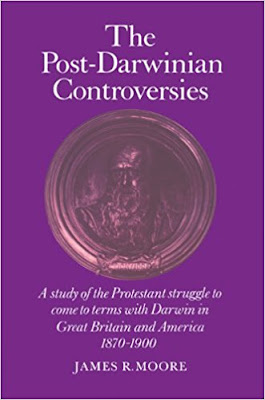 1.) James R. Moore, The Post-Darwinian Controversies: A Study of the Protestant Struggle to Come to Terms with Darwin in Great Britain and America 1870-1900 (Cambridge: Cambridge University Press, 1979), 502pp.
Written in 1979, this was not only a ground breaking work in that it argues that Orthodox Calvinist theology, more so than its liberal counterparts, often found itself very well suited to interacting with and adopting Darwin's theory. It was, moreover, one of the first major works to examine in depth the so-called "Warfare" or "Conflict" model popularized by John William Draper and Andrew Dixon White at the end of the 19th century. Strangely enough, to this day it remains one of the most in-depth studies of how the spurious "warfare" narrative of science and Christianity spread, even into ostensibly "objective" histories. If you are at all interested in the history of Darwinism and religion (particularly, Christianity), this is a must-read. It has set the historiographical tone since its publication, and with little doubt can be named as one of the most important publications on Darwin in the latter-half of the twentieth-century.
 2.) Ronald L. Numbers, The Creationists: From Scientific Creationism to Intelligent Design - Expanded Edition (Cambridge, MA: Harvard University Press, 1992, 2006), 606pp.
While many assume six-day creationism is the default historical position of Christianity, this is not at all the case. If you mentioned the term "Creationist" in the mid-19th century, it would have invoked images of a debate about whether souls are created in children at conception (the creationist position), or whether they are somehow passed down as a combinatorial inheritance of the parents (often called Traducianism). The fascinating, and often very strange story of the rise of creationism, and eventually "scientific" creationism, is expertly and even-handedly told by historian Ronald Numbers. Now in a second edition, new material covers the genesis and career of the Intelligent Design movement as well. While there are many good introductions, this is the definitive account.
 3.) Peter Bowler, The Non-Darwinian Revolution: Reinterpreting a Historical Myth (Baltimore, MA: Johns Hopkins University Press, 1988), 239pp.
A little known fact about Darwin's theory of evolution is that it almost died completely. While the typical stories surrounding Darwinism narrate its steady--almost inevitable--ascendancy to dominance after Darwin proposed it in the Origin, the real story is much more convoluted. As a matter of fact, while most found evolution itself compelling, one of the sole unique contributions of Darwin--the theory of natural selection--was almost universally rejected. Even Darwin's "Bulldog" Thomas Huxley accepted natural selection only after many years, and then with great hesitation. In the early decades of the twentieth century many talked about the death of Darwin's theory because there was no known mechanism that could account for genetic transmission in the way that Darwin's theory needed. Not until it was combined with the theory of genetics first proposed by the Augustinian monk Gregor Mendel, was Darwinism's theory of selection vindicated (under what we now call the "neo-Darwinian synthesis"). Not without its detractors, Bowler's work goes a long way toward demolishing the typically "Whiggish" and necessitarian accounts of Darwin's inevitable ascendancy. In the same vein, reader's should check out his latest book Darwin Deleted, which provides a fascinating counterfactual history regarding how evolutionary theory would have advanced had Darwin never existed. His research has also led to what is probably the best historical introduction to evolution to date, Evolution: The History of an Idea.
 4.) Martin J.S. Rudwick, Earth's Deep History: How It Was Discovered and Why It Matters (Chicago: University of Chicago Press, 2014), 360pp.
Many assume that Archbishop Ussher's dating of creation to 4004BC was the final word regarding how the Bible related to the age of the earth. History of geology expert Martin Rudwick paints the fantastically complex (and fascinating) narrative of how Christian geologists were often the first to investigate and announce the deepening age of the earth. Even Ussher was no slavish literalist, but was rather relying on the best historical data of his day from Persian, Chinese, Babylonian, and Arabic sources. Far from a war of science with religion, the history of geology shows the many complex and nuanced ways Christian theology actually helped prime certain ideas that became standard in geological science. But what is more, Rudwick simply tells a well narrated story of the rise of geology that reflects decades of expertise.
 5.) James A. Secord, Victorian Sensation: The Extraordinary Publication, Reception, and Secret Authorship of Vestiges of the Natural History of Creation (Chicago: University of Chicago Press, 2000), 624pp.
Considered in turns shocking, thrilling, horrifying, magnificent, the anonymously penned Vestiges of the Natural History of Creation (which we now know was written by the Scotsman Robert Chambers), even more perhaps than Darwin's Origin which came later, primed Victorian audiences for the debate over evolution and theology. Depending upon whom one asked, the Vestiges was either a stunning display of theological synthesis with evolution, or an abomination that must have been published by the anti-Christ. Unfortunately, despite the fact that nearly everyone in the Victorian period had an opinion on the Vestiges, its legacy--especially leading into the debates over Darwin--have largely been forgotten. James Secord's masterwork not only corrects this, but provides a stunning proof-of-concept regarding how print and book culture provide a methodological key for historiographical analysis. If Number's The Creationists is vital to read in regards to the construction of the creationist-evolutionist debates, Secord's work is vital to understand the underlying tensions leading up to Darwin's publication.
 6.) Bradley J. Gundlach, Process and Providence: The Evolution Question at Princeton, 1845-1929 (Grand Rapids: Eerdmans Publishing, 2013), 374pp.
Darwin published, and the theological world had a epileptic fit of protest. Or, at least, this is the typical story (in whatever variation) that is told. However, regardless of where they ultimately landed on the issue, theologians actually had acute and in-depth engagement with Darwin. Despite being represented as having been bested by Thomas Huxley, for example, Darwin himself noted that Bishop Samuel Wilberforce in his review of the Origin had uncannily seen its theoretical heart, and in his critiques he "picked out the most speculative" and problematic bits with the precision of a surgeon. So too, Gundlach's book here narrates how many theologians at Princeton--a bastion of evangelical orthodoxy--received and interpreted Darwin's theory. Anyone who wants to responsible deal with early theological reception of Darwin needs to read this work.
 7.) Adam R. Shapiro, Trying Biology: The Scopes Trial, Textbooks, and the Antievolution Movement in American Schools (Chicago: University of Chicago Press, 2013), 200pp.
Shapiro's book demonstrates with a startling precision how the Scopes trial was constructed to display a "science vs. religion" debate--a conspiracy of all sides, as it were. From textbook politics, to folks trying to bolster the local Dayton economy by saying it represented the typical town in any location in America, to the fact that everyone just wanted a good show, Shapiro's study is absolutely vital to understand the subtexts of the Scope's Trial that are all too often missed in sensational historiography based on media headlines. This, as well as Moran's book below, are perfect compliments to Edward Larson's Summer for the Gods.
 8.) David N. Livingstone, Dealing With Darwin: Place, Politics, and Rhetoric in Religious Engagements with Evolution (Baltimore, MA: Johns Hopkins University Press, 2014), 280pp.
Based on his Gifford Lectures, Livingstone shows in a stunning manner how Calvinists of all stripes received Darwin differently depending upon their geographic (and hence differently traditioned) locations. One's reaction to Darwin as such depended less on one's theology, and more on the connotations one linked with said theology, as well as science, society, and economics (to name but a few of the mitigating factors). While one needs to read Livingstone's work demolishing myths about evangelical reception of Darwinism--Darwin's Forgotten Defenders: The Encounter Between Evangelical Theology and Evolutionary Thought--this is not only a necessary work to include in one's Darwiniana, but is also a premier representative of the so-called "Spatial Turn" in the historiography of science and religion.
 9.) Matthew Stanley, Huxley's Church and Maxwell's Demon: From Theistic Science to Naturalistic Science (Chicago: University of Chicago Press, 2014), 336pp.
At the outset of this post we mentioned that notions of materialism's or atheism's triumph over religion in the wake of Darwin was less a victory of reason, and more a victory at the level of historical representation. Matthew Stanley thoroughly demonstrates this thesis. He shows how Thomas Huxley was not just Darwin's hype-man, but the chief historian narrating the rise of evolutionary theory. To this end, Huxley did not so much argue against theologians (though there was a lot of this), but more primarily narrated them out of history. This ended up obscuring the fact that Huxley--along with Darwin--shared nearly identical methodological concerns to contemporary theistic scientists like James Clerk Maxwell.
 10.) Jeffrey P. Moran, American Genesis: The Evolution Controversies from Scopes to Creation Science (Oxford: Oxford University Press, 2012), 196pp.
The Scopes Trial has been examined by so many for so long, it often becomes difficult to imagine there would be anything new to say. Moran proves that intuition wrong by pointing out how, for example, race and racial prejudice played a major factor in the differing receptions of Darwin among Black Church communities, as did several societies of Christian mothers who were relentless in marshaling opposition to Darwinism for fear of their son's and daughter's morality. Moran shows how often it was that social Darwinism--and not Darwinism per se--was on trial. A short read, this volume packs a hefty methodological punch as it reveals how taking new perspectives on the Scopes trial--and the controversies over evolution generally--can shed light. To boot, there is a wonderfully narrated audiobook version.
 11.) Neal C. Gillespie, Charles Darwin and the Problem of Creation (Chicago: University of Chicago Press, 1979), 224pp.
Ignore the really weird cover art. This is one of the first investigations to question the materialist interpretation of Darwin that had by then become canon--and was reinforced by the spate of historiographical works coming out in 1959 at the Centenary of Darwin's publication of the Origin--Gillespie argues that Darwin was still thoroughly dependent upon the world as envisioned by Victorian natural theologians. Which is not to say somehow his science was reducible to his theology, but it is to say that the science vs. theology narrative needs deep reconsideration. One of the intriguing ways this can be seen is the overt defensiveness of many of Darwin's materialist interpreters (Huxley included). "The first generation [of Darwin's materialist apologists] displays a defensiveness that shows all too well that the old ideas still make sense to them" (p.5). This thesis would later be expanded upon and meticulously nuanced by Dov Ospovat's compelling work The Development of Darwin's Theory: Natural History, Natural Theology, and Natural Selection 1838-1859. Gillespie also shows that modern creationism and scientific positivism actually shared a common core of beliefs. And that this was so allows one to see that "creationism ... was [intrinsically] unstable owing to the development of positivism within it" (7). In other words, the creationist vs. evolutionist debate was not inevitable, or somehow based on the essence of Christianity itself, but came about in part because Christian theology mutilated its classic forms as it attempted to become a positivist science in the late 19th and early-20th centuries.
 12.) Frank M. Turner, Contesting Cultural Authority: Essays in Victorian Intellectual Life (Cambridge: Cambridge University Press, 1993), 368pp.
This is a study looking at conflicts of science and religion in the Victorian period, par excellence. Interested in Darwinism and religion in the Victorian period? Buy this volume. Read it. Underline prodigiously. There are four or five essays in this volume worth the price of admission by themselves. As with many of the volumes in this list, Turner argues that the supposed conflict of science and religion does turn on certain tensions, but these are wholly exaggerated (and sometimes wholly invented) by historiographical representations of Darwin, or theology. "Certainly if one message tended to come through much of the work surrounding the centenary of On the Origin of Species [in 1959], it was the generally positivistic [and anti-theological] character of Darwinian science" (18). Yet, such readings constituted a tactic of ignoring the theological reasoning that saturated Darwin and "citing only the positivistic passages from Darwin and other scientists" (24). The materialist interpretation of evolution is in terms of history a self-fulfilling prophecy.
 13.) Jessica Riskin, The Restless Clock: A History of the Centuries-Long Argument Over What Makes Living Things Tick (Chicago: University of Chicago Press, 2016), 544pp.
"A contradiction sits at the origin of modern science," writes Riskin. "The principle responsible for defining scientific explanations as distinct from religious and mystical ones as the prohibition on appeals to agency and will." Thus, she continues: "This principle [of outlawing agency in science] itself relied for its establishment upon a theological notion, the divine Engineer, and a theological program, the argument from design." As such when the pioneers of modern science noted that they were banishing mysterious agencies from nature, "they predicated their rigorously naturalistic approach on a supernatural power" (p.4). What results from this provocative thesis is a rigorous and fascinating (and nearly 600 page) historical analysis that largely corroborates many of Margaret Osler's earlier arguments regarding the subterranean influence of theology in biology and science broadly regarding natural law and "what makes living things tick."
 14.) Robert J. Richards, The Meaning of Evolution: The Morphological Construction and Ideological Reconstruction of Darwin's Theory (Chicago: University of Chicago Press, 1993), 222 pages.
Another pillar of the canon in Darwinian scholarship is that evolution is fundamentally non-teleological. There is a certain truth to this given the role that contingency plays. But as Richards argues a completely non-teleological interpretation is in fact an ideology (we might say, an anti-theological, anti-religious ideology) passed down by historians and scientists alike. As Richard's notes, however, "Darwin's theory both before and after Malthus remained a theory of evolutionary progress" (p.114). Indeed, "Darwin considered his theory a guarantee of general progress, even if in some general instances one had to admit a slide into the more primitive" (143). Once again, we witness a transmutation of the theory at the level of history, which one would not be without warrant to consider an effect of intending to exaggerate the anti-religious aspects of the theory.
 15.) Timothy Larsen, The Crisis of Doubt: Honest Faith in Nineteenth-Century England (Oxford: Oxford University Press, 2009), 330 pages.
Much like Turner's volume above, this is a must read to debunk some prevalent Victorian myths that still haunt us today. As Larsen opens, "The nineteenth-century crisis of faith is a motif that has been vastly overblown" (p.1). Indeed, "the strength of the narrative of the Victorian crisis of faith has had the effect of excluding from view much of the [actual] religious life and history of the period" (p.2). In other words, the supposed "crisis of faith" caused by Darwinism and other factors has been proven by being assumed, and used as a yardstick to measure what counts as historical evidence. To counter this, Larsen narrates the lives of several academics who began as skeptics during this period, and ended up ardent proponents of the Christian faith.
As it turns out, much of the received opinion regarding Darwin's findings, the religious reception of Darwin's theories, and the implications for theology, are largely a matter of historiography--that is, representations of Darwin that have been handed down over the years. While there can be no denying the tensions that exist between interpretations of Darwin and Christian theology, the assumption that Darwin defeated God and the Bible, and left theologians broken and scattered about the crater that the Origin and the Descent of Man left, is less a victory for "science vs. religion" in the realm of ideas, than at the level of historiographical representation of the post-Darwinian course of history. Much like interpretations surrounding the Galileo affair (some of which we have covered here) historical reception often skews complexity in favor of simple binaries. Thus in order to compliment my other lists of must-reads in the historiography of science and religion (here, here, here), I now turn to a list dedicate to Darwin, Darwinism, and movements that surrounded them.
There are a few rules that this list tries to abide by: first, these are primarily historical studies. I will soon make another list about Darwinian theory today, but that isn't this list. Second, these are works I personally have read and benefitted from. There are no doubt countless other excellent and important works out there--I simply haven't yet had the opportunity to interact with them (leave me recommendations!) I also have tried to stick to one book per author (though I cheat a little by mentioning some of their other works here and there). Thus, when you see an author's name here, rest assured they most probably have a host of other interesting and relevant works that were left off.
Without further ado, then, the list for your summer reading pleasure:

Written in 1979, this was not only a ground breaking work in that it argues that Orthodox Calvinist theology, more so than its liberal counterparts, often found itself very well suited to interacting with and adopting Darwin's theory. It was, moreover, one of the first major works to examine in depth the so-called "Warfare" or "Conflict" model popularized by John William Draper and Andrew Dixon White at the end of the 19th century. Strangely enough, to this day it remains one of the most in-depth studies of how the spurious "warfare" narrative of science and Christianity spread, even into ostensibly "objective" histories. If you are at all interested in the history of Darwinism and religion (particularly, Christianity), this is a must-read. It has set the historiographical tone since its publication, and with little doubt can be named as one of the most important publications on Darwin in the latter-half of the twentieth-century.

While many assume six-day creationism is the default historical position of Christianity, this is not at all the case. If you mentioned the term "Creationist" in the mid-19th century, it would have invoked images of a debate about whether souls are created in children at conception (the creationist position), or whether they are somehow passed down as a combinatorial inheritance of the parents (often called Traducianism). The fascinating, and often very strange story of the rise of creationism, and eventually "scientific" creationism, is expertly and even-handedly told by historian Ronald Numbers. Now in a second edition, new material covers the genesis and career of the Intelligent Design movement as well. While there are many good introductions, this is the definitive account.

A little known fact about Darwin's theory of evolution is that it almost died completely. While the typical stories surrounding Darwinism narrate its steady--almost inevitable--ascendancy to dominance after Darwin proposed it in the Origin, the real story is much more convoluted. As a matter of fact, while most found evolution itself compelling, one of the sole unique contributions of Darwin--the theory of natural selection--was almost universally rejected. Even Darwin's "Bulldog" Thomas Huxley accepted natural selection only after many years, and then with great hesitation. In the early decades of the twentieth century many talked about the death of Darwin's theory because there was no known mechanism that could account for genetic transmission in the way that Darwin's theory needed. Not until it was combined with the theory of genetics first proposed by the Augustinian monk Gregor Mendel, was Darwinism's theory of selection vindicated (under what we now call the "neo-Darwinian synthesis"). Not without its detractors, Bowler's work goes a long way toward demolishing the typically "Whiggish" and necessitarian accounts of Darwin's inevitable ascendancy. In the same vein, reader's should check out his latest book Darwin Deleted, which provides a fascinating counterfactual history regarding how evolutionary theory would have advanced had Darwin never existed. His research has also led to what is probably the best historical introduction to evolution to date, Evolution: The History of an Idea.

Many assume that Archbishop Ussher's dating of creation to 4004BC was the final word regarding how the Bible related to the age of the earth. History of geology expert Martin Rudwick paints the fantastically complex (and fascinating) narrative of how Christian geologists were often the first to investigate and announce the deepening age of the earth. Even Ussher was no slavish literalist, but was rather relying on the best historical data of his day from Persian, Chinese, Babylonian, and Arabic sources. Far from a war of science with religion, the history of geology shows the many complex and nuanced ways Christian theology actually helped prime certain ideas that became standard in geological science. But what is more, Rudwick simply tells a well narrated story of the rise of geology that reflects decades of expertise.

Considered in turns shocking, thrilling, horrifying, magnificent, the anonymously penned Vestiges of the Natural History of Creation (which we now know was written by the Scotsman Robert Chambers), even more perhaps than Darwin's Origin which came later, primed Victorian audiences for the debate over evolution and theology. Depending upon whom one asked, the Vestiges was either a stunning display of theological synthesis with evolution, or an abomination that must have been published by the anti-Christ. Unfortunately, despite the fact that nearly everyone in the Victorian period had an opinion on the Vestiges, its legacy--especially leading into the debates over Darwin--have largely been forgotten. James Secord's masterwork not only corrects this, but provides a stunning proof-of-concept regarding how print and book culture provide a methodological key for historiographical analysis. If Number's The Creationists is vital to read in regards to the construction of the creationist-evolutionist debates, Secord's work is vital to understand the underlying tensions leading up to Darwin's publication.

Darwin published, and the theological world had a epileptic fit of protest. Or, at least, this is the typical story (in whatever variation) that is told. However, regardless of where they ultimately landed on the issue, theologians actually had acute and in-depth engagement with Darwin. Despite being represented as having been bested by Thomas Huxley, for example, Darwin himself noted that Bishop Samuel Wilberforce in his review of the Origin had uncannily seen its theoretical heart, and in his critiques he "picked out the most speculative" and problematic bits with the precision of a surgeon. So too, Gundlach's book here narrates how many theologians at Princeton--a bastion of evangelical orthodoxy--received and interpreted Darwin's theory. Anyone who wants to responsible deal with early theological reception of Darwin needs to read this work.

Shapiro's book demonstrates with a startling precision how the Scopes trial was constructed to display a "science vs. religion" debate--a conspiracy of all sides, as it were. From textbook politics, to folks trying to bolster the local Dayton economy by saying it represented the typical town in any location in America, to the fact that everyone just wanted a good show, Shapiro's study is absolutely vital to understand the subtexts of the Scope's Trial that are all too often missed in sensational historiography based on media headlines. This, as well as Moran's book below, are perfect compliments to Edward Larson's Summer for the Gods.

Based on his Gifford Lectures, Livingstone shows in a stunning manner how Calvinists of all stripes received Darwin differently depending upon their geographic (and hence differently traditioned) locations. One's reaction to Darwin as such depended less on one's theology, and more on the connotations one linked with said theology, as well as science, society, and economics (to name but a few of the mitigating factors). While one needs to read Livingstone's work demolishing myths about evangelical reception of Darwinism--Darwin's Forgotten Defenders: The Encounter Between Evangelical Theology and Evolutionary Thought--this is not only a necessary work to include in one's Darwiniana, but is also a premier representative of the so-called "Spatial Turn" in the historiography of science and religion.

At the outset of this post we mentioned that notions of materialism's or atheism's triumph over religion in the wake of Darwin was less a victory of reason, and more a victory at the level of historical representation. Matthew Stanley thoroughly demonstrates this thesis. He shows how Thomas Huxley was not just Darwin's hype-man, but the chief historian narrating the rise of evolutionary theory. To this end, Huxley did not so much argue against theologians (though there was a lot of this), but more primarily narrated them out of history. This ended up obscuring the fact that Huxley--along with Darwin--shared nearly identical methodological concerns to contemporary theistic scientists like James Clerk Maxwell.

The Scopes Trial has been examined by so many for so long, it often becomes difficult to imagine there would be anything new to say. Moran proves that intuition wrong by pointing out how, for example, race and racial prejudice played a major factor in the differing receptions of Darwin among Black Church communities, as did several societies of Christian mothers who were relentless in marshaling opposition to Darwinism for fear of their son's and daughter's morality. Moran shows how often it was that social Darwinism--and not Darwinism per se--was on trial. A short read, this volume packs a hefty methodological punch as it reveals how taking new perspectives on the Scopes trial--and the controversies over evolution generally--can shed light. To boot, there is a wonderfully narrated audiobook version.

Ignore the really weird cover art. This is one of the first investigations to question the materialist interpretation of Darwin that had by then become canon--and was reinforced by the spate of historiographical works coming out in 1959 at the Centenary of Darwin's publication of the Origin--Gillespie argues that Darwin was still thoroughly dependent upon the world as envisioned by Victorian natural theologians. Which is not to say somehow his science was reducible to his theology, but it is to say that the science vs. theology narrative needs deep reconsideration. One of the intriguing ways this can be seen is the overt defensiveness of many of Darwin's materialist interpreters (Huxley included). "The first generation [of Darwin's materialist apologists] displays a defensiveness that shows all too well that the old ideas still make sense to them" (p.5). This thesis would later be expanded upon and meticulously nuanced by Dov Ospovat's compelling work The Development of Darwin's Theory: Natural History, Natural Theology, and Natural Selection 1838-1859. Gillespie also shows that modern creationism and scientific positivism actually shared a common core of beliefs. And that this was so allows one to see that "creationism ... was [intrinsically] unstable owing to the development of positivism within it" (7). In other words, the creationist vs. evolutionist debate was not inevitable, or somehow based on the essence of Christianity itself, but came about in part because Christian theology mutilated its classic forms as it attempted to become a positivist science in the late 19th and early-20th centuries.

This is a study looking at conflicts of science and religion in the Victorian period, par excellence. Interested in Darwinism and religion in the Victorian period? Buy this volume. Read it. Underline prodigiously. There are four or five essays in this volume worth the price of admission by themselves. As with many of the volumes in this list, Turner argues that the supposed conflict of science and religion does turn on certain tensions, but these are wholly exaggerated (and sometimes wholly invented) by historiographical representations of Darwin, or theology. "Certainly if one message tended to come through much of the work surrounding the centenary of On the Origin of Species [in 1959], it was the generally positivistic [and anti-theological] character of Darwinian science" (18). Yet, such readings constituted a tactic of ignoring the theological reasoning that saturated Darwin and "citing only the positivistic passages from Darwin and other scientists" (24). The materialist interpretation of evolution is in terms of history a self-fulfilling prophecy.

"A contradiction sits at the origin of modern science," writes Riskin. "The principle responsible for defining scientific explanations as distinct from religious and mystical ones as the prohibition on appeals to agency and will." Thus, she continues: "This principle [of outlawing agency in science] itself relied for its establishment upon a theological notion, the divine Engineer, and a theological program, the argument from design." As such when the pioneers of modern science noted that they were banishing mysterious agencies from nature, "they predicated their rigorously naturalistic approach on a supernatural power" (p.4). What results from this provocative thesis is a rigorous and fascinating (and nearly 600 page) historical analysis that largely corroborates many of Margaret Osler's earlier arguments regarding the subterranean influence of theology in biology and science broadly regarding natural law and "what makes living things tick."

Another pillar of the canon in Darwinian scholarship is that evolution is fundamentally non-teleological. There is a certain truth to this given the role that contingency plays. But as Richards argues a completely non-teleological interpretation is in fact an ideology (we might say, an anti-theological, anti-religious ideology) passed down by historians and scientists alike. As Richard's notes, however, "Darwin's theory both before and after Malthus remained a theory of evolutionary progress" (p.114). Indeed, "Darwin considered his theory a guarantee of general progress, even if in some general instances one had to admit a slide into the more primitive" (143). Once again, we witness a transmutation of the theory at the level of history, which one would not be without warrant to consider an effect of intending to exaggerate the anti-religious aspects of the theory.

Much like Turner's volume above, this is a must read to debunk some prevalent Victorian myths that still haunt us today. As Larsen opens, "The nineteenth-century crisis of faith is a motif that has been vastly overblown" (p.1). Indeed, "the strength of the narrative of the Victorian crisis of faith has had the effect of excluding from view much of the [actual] religious life and history of the period" (p.2). In other words, the supposed "crisis of faith" caused by Darwinism and other factors has been proven by being assumed, and used as a yardstick to measure what counts as historical evidence. To counter this, Larsen narrates the lives of several academics who began as skeptics during this period, and ended up ardent proponents of the Christian faith.

Comments