So, You Want to Read About the History of Science and Christianity?: Key Works (Part One)
This is my final semester at Seminary, and my final class is an elective guided studies course I designed, along with the professor who kindly agreed to supervise my work. This class focuses on reading everything we can get our hands on regarding the history of science and Christianity--in particular with an attempt to complexify any straightforward "Christianity hindered science," or its equal but opposite extreme "science would never have arisen without Christianity" (a thesis, for example, recently argued by Rodney Stark). We decided we wanted to focus on the historical aspects, rather than the more "analytic" aspects of philosophy of science, though obviously this can often have blurry lines (and at other points we couldn't help ourselves and threw in a few interesting looking books anyway). Here is just a brief look at some of the reading we will be doing, just in case you yourself are interested and want some places to start! I hope in theory to blog a little about each book in the future (the best of intentions...) so I will limit description here to a sentence or two.
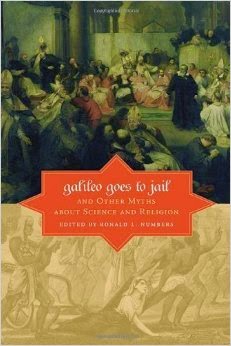 Ronald Numbers, ed., Galileo Goes to Jail, and Other Myths About Science and Religion (Harvard University Press, 2010), 320pp.
An extremely fun read, this is probably the easiest and best place to start for anyone looking to dive in to the histories of Christianity (or more broadly, religion) and science. Covering topics ranging from the title's suggestion, to whether Christianity was responsible for the demise of ancient science, whether the church taught the earth was flat, to more obscure topics like theologians supposedly prohibiting dissections, each essay is very brief (usually 8-11 pages) and very informative.
 Ronald Numbers and David Lindberg, eds., God & Nature: Historical Essays on the Encounter Between Christianity and Science, (University of California, 1986), 516pp.
I wrote a short interaction on this one already, so I will not comment much further. Needless to say, despite being slightly dated this still stands as the go-to introductory volume. Its essays are drier and lengthier than Galileo Goes to Jail, but they are also more informative, if less pithy.
 John Hedley Brooke and Geoffrey Cantor, Reconstructing Nature: The Engagement of Science and Relgion (Oxford, 2000), 386pp.
Based on their mutual Glasgow Gifford lectures, this is a fascinating volume that argues no "the relation of science and Christianity" thesis can be argued from a historical perspective. Rather, much like William Cavanaugh argues in his The Myth of Religious Violence, both Brooke and Cantor argue that what counts as science, and what counts as theology, and what their interactions are, are dictated by the terms of any given period--indeed often even by individuals within any given period. As such this book is really a series of in-depth vignettes into differing case-studies looking at the complicated ways science and theology implicated one another.
 John Hedley Brooke, Science and Religion: Some Historical Perspectives, (Cambridge, 2014), 552pp.
Undoubtedly serving as inspiration for his Glasgow Gifford lectures with Geoffery Cantor (above), this is essentially a historical survey by Brooke again arguing the thesis that the so-called "warfare" narrative between science and religion is untenable. This is an absolutely fantastic book bristling with insights, and of all the books in the list has been my favorite thus far. Brooke has an uncanny knack for sensing the ambiguities within historically held positions, and indeed is ever-vigilante to point out to the (sometimes bewildered!) reader the nuances and complexities that must go into even asking the proper historical questions. Just one little nugget to wet the appetite: when asking: "how did the church react to the Copernican hypothesis?" Brooke points out that this is a "deliciously ambiguous" question. Why? Because, though quite alien to our common mindset today, there was still a prevalent and strict (largely Aristotelian) distinction between appreciating a theory as a mathematical construct (which many did) that was able to make predictions, and understanding it as a physical theory (which many did not, even when accepting its mathematical niceties) describing the makeup of the universe. At this point Brooke makes the slightly mind bending observation: "this means that at the time it would be more radical to consider the theory as a physical description and to reject it, than to accept it as a mere mathematical model." As such to ask: who was a Copernican? is not quite the right question, for it assumes the modern perspective that to accept a theory means one also accepts the myriad of its physical implications. But this is precisely to miss the complexities of the historical positions actually held.
 Ronald Numbers, Darwinism Comes to America (Harvard, 1996), 224pp.
A (mercifully) brief and yet extremely informative read (the actual content runs only about 140 pages, the rest is composed of a glossary, the extensive endnotes, and bibliography) this is quintessential for those who want to learn what the real reactions to Darwin were. The answers are surprising. Much like the focus of Brooke's, here Numbers says "definitions mean everything." He even chides himself a bit, noting that in his previous mammoth work The Creationists, he did not, surprisingly, actually investigate the historical rise of the range of ideas meant by the term "creationist." Interestingly enough it was not until the 1960's that the word became associated with "anti-Darwinian," and this itself was primarily at the behest of 7th-day Adventist advocates of a literal six-day creation. Other surprises abound: only one of the original formulators of "The Fundamentals" was a six-day "literalist." Most others typically painted with a "fundamentalist brush" including William Jennings Bryan of Scopes Trial fame) accepted either the day-age theory, or the Gap interpretations of Genesis. Numbers has a keen eye for detail, and represents that detail in crystal clear (and even occasionally humorous) prose.
 Edward Grant, The Foundations of Modern Science in the Middle Ages: Their Religious, Institutional, and Intellectual Contexts (Cambridge, 1996), 266pp.
As one might have already gathered from the preceding books: historiographical decisions, tropes, and analogies matter. They often shape how we perceive history, even in implicit ways. One of those implicitly guided tropes is the concept of a "scientific revolution" in the 17th and 18th centuries. To be sure, the genius of Galileo, and others like Newton, cannot be denied. And yet, much like the epithet "Renaissance," secretly relying on the assertion of a prior "Dark Ages" (equally a myth), the scientific "revolution" is often presented against the darkness of a thousand years of Christian ignorance. Not so. Here Grant details how the conceptual, mathematical, and even occasionally proto-experimental mentalities of Medieval scholastic Christians often set the stage for later development of ideas like inertia, vacuum, heliocentricism, etc...
 James Hannam, The Genesis of Science: How the Christian Middle Ages Launched the Scientific Revolution (Regnery, 2011), 448pp.
Whereas Grants work, above, focuses on the Middle ages as precedent for the scientific revolution in terms of how theory and mathematics emerged from Scholastic discussions, Hannams work is a great compliment in focusing on more practical developments in science during the middle ages such as the stirrups, horseshoes, plows, and other devices. Square in Hannam's sights is the dismantling of the epithet "Medieval" to mean "scientifically backward." Ironically, as he points out, if we wanted to talk about a "scientifically backward" era (though he does not descend into this polemic) one would have to cite the Romans (!) here, not the "Middle Ages" of Scholasticism. Despite monumental achievements like the aqueducts, the Romans had no notable scientific advancements over the Greeks, they merely applied Roman power and rigor to previously established technique.
An extremely fun read, this is probably the easiest and best place to start for anyone looking to dive in to the histories of Christianity (or more broadly, religion) and science. Covering topics ranging from the title's suggestion, to whether Christianity was responsible for the demise of ancient science, whether the church taught the earth was flat, to more obscure topics like theologians supposedly prohibiting dissections, each essay is very brief (usually 8-11 pages) and very informative.
I wrote a short interaction on this one already, so I will not comment much further. Needless to say, despite being slightly dated this still stands as the go-to introductory volume. Its essays are drier and lengthier than Galileo Goes to Jail, but they are also more informative, if less pithy.
Based on their mutual Glasgow Gifford lectures, this is a fascinating volume that argues no "the relation of science and Christianity" thesis can be argued from a historical perspective. Rather, much like William Cavanaugh argues in his The Myth of Religious Violence, both Brooke and Cantor argue that what counts as science, and what counts as theology, and what their interactions are, are dictated by the terms of any given period--indeed often even by individuals within any given period. As such this book is really a series of in-depth vignettes into differing case-studies looking at the complicated ways science and theology implicated one another.
Undoubtedly serving as inspiration for his Glasgow Gifford lectures with Geoffery Cantor (above), this is essentially a historical survey by Brooke again arguing the thesis that the so-called "warfare" narrative between science and religion is untenable. This is an absolutely fantastic book bristling with insights, and of all the books in the list has been my favorite thus far. Brooke has an uncanny knack for sensing the ambiguities within historically held positions, and indeed is ever-vigilante to point out to the (sometimes bewildered!) reader the nuances and complexities that must go into even asking the proper historical questions. Just one little nugget to wet the appetite: when asking: "how did the church react to the Copernican hypothesis?" Brooke points out that this is a "deliciously ambiguous" question. Why? Because, though quite alien to our common mindset today, there was still a prevalent and strict (largely Aristotelian) distinction between appreciating a theory as a mathematical construct (which many did) that was able to make predictions, and understanding it as a physical theory (which many did not, even when accepting its mathematical niceties) describing the makeup of the universe. At this point Brooke makes the slightly mind bending observation: "this means that at the time it would be more radical to consider the theory as a physical description and to reject it, than to accept it as a mere mathematical model." As such to ask: who was a Copernican? is not quite the right question, for it assumes the modern perspective that to accept a theory means one also accepts the myriad of its physical implications. But this is precisely to miss the complexities of the historical positions actually held.
A (mercifully) brief and yet extremely informative read (the actual content runs only about 140 pages, the rest is composed of a glossary, the extensive endnotes, and bibliography) this is quintessential for those who want to learn what the real reactions to Darwin were. The answers are surprising. Much like the focus of Brooke's, here Numbers says "definitions mean everything." He even chides himself a bit, noting that in his previous mammoth work The Creationists, he did not, surprisingly, actually investigate the historical rise of the range of ideas meant by the term "creationist." Interestingly enough it was not until the 1960's that the word became associated with "anti-Darwinian," and this itself was primarily at the behest of 7th-day Adventist advocates of a literal six-day creation. Other surprises abound: only one of the original formulators of "The Fundamentals" was a six-day "literalist." Most others typically painted with a "fundamentalist brush" including William Jennings Bryan of Scopes Trial fame) accepted either the day-age theory, or the Gap interpretations of Genesis. Numbers has a keen eye for detail, and represents that detail in crystal clear (and even occasionally humorous) prose.
As one might have already gathered from the preceding books: historiographical decisions, tropes, and analogies matter. They often shape how we perceive history, even in implicit ways. One of those implicitly guided tropes is the concept of a "scientific revolution" in the 17th and 18th centuries. To be sure, the genius of Galileo, and others like Newton, cannot be denied. And yet, much like the epithet "Renaissance," secretly relying on the assertion of a prior "Dark Ages" (equally a myth), the scientific "revolution" is often presented against the darkness of a thousand years of Christian ignorance. Not so. Here Grant details how the conceptual, mathematical, and even occasionally proto-experimental mentalities of Medieval scholastic Christians often set the stage for later development of ideas like inertia, vacuum, heliocentricism, etc...
James Hannam, The Genesis of Science: How the Christian Middle Ages Launched the Scientific Revolution (Regnery, 2011), 448pp.Whereas Grants work, above, focuses on the Middle ages as precedent for the scientific revolution in terms of how theory and mathematics emerged from Scholastic discussions, Hannams work is a great compliment in focusing on more practical developments in science during the middle ages such as the stirrups, horseshoes, plows, and other devices. Square in Hannam's sights is the dismantling of the epithet "Medieval" to mean "scientifically backward." Ironically, as he points out, if we wanted to talk about a "scientifically backward" era (though he does not descend into this polemic) one would have to cite the Romans (!) here, not the "Middle Ages" of Scholasticism. Despite monumental achievements like the aqueducts, the Romans had no notable scientific advancements over the Greeks, they merely applied Roman power and rigor to previously established technique.
Comments