Book Review: Stephen Holmes, Quest for the Trinity
Note: This review of mine was originally published in The Journal of Cultural Encounters vol.9 no.1 (2013): 102-108
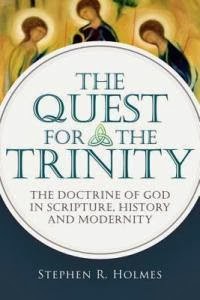
Stephen R. Holmes, The
Quest for the Trinity: The Doctrine of God in Scripture, History, and Modernity
(Downers Grove, IL: IVP, 2012), 231pp.
Time, of course, is not a transparent medium; of the future we can
glimpse only the shadows of possibilities, and whatever we can discern of the
past recedes incessantly into an ever greater distance, and is visible usually
only through the distorting atmosphere of the preoccupations of the present.
--David Bentley Hart[1]
Those who
narrate the story of God clearly wield no little authority. The same can be said for those who narrate the
story of the doctrine of God.
To produce
a concise statement somehow encapsulating the mood and posture of that
perennially occult entity “modern theology” is one of the more elusive
incantations of the academic. Many
helpful attempts have been put forth, but for the sake of simplicity if we
might assume Walter Kasper’s formula—that “the history of modern thought” is,
at one level, “a history of the many attempts to reconstruct the doctrine of
the trinity,”[3]—we
might also gain immediate ground to understand the wonderful blurb by Karen
Kilby branding the backside of Stephen Holmes’ latest book, The Quest for the Trinity. “It is,” she says, “rare to write something
that is both a textbook and a real intervention in a debate.” That a textbook be also an intervention, and
an intervention a textbook, emerges precisely from an intentionally blurred
line between the systematic and historical ‘moments’ of theology: Holmes’ book,
as a historical overview of the development of Trinitarian doctrine (and so:
textbook), undercuts much of the colloquy of modern trinitarianism at its historiographical
heart (and so: intervention). For a
major characteristic of these projects is that they are built upon the
scaffolding of historical diagnostics: if the Trinity ended up marginalized,
something somewhere went wrong and a good deal of sleuthing is needed to trace
such ailments to find patient zero. So
goes the vast drift of today’s modern Trinitarianism: much of the vogue of our current decision making strategies
in theology are driven precisely by the subtext of the historical narration
they piggy-back upon (against patriarchalism-hierarchicalism, classical-theism,
Constantinianism, substance metaphysics, Greek East vs. Latin West, Hellenization,
onto-theology, and the like). Yet, what happens when these fundamental
historical narratives (what Patristic scholar Lewis Ayres has elsewhere called
the “tropes” of a culture of modern systematic theology) turn out to be
misleading, or even fundamentally incorrect?
So enters Holmes. “I argue,” he writes, “that the explosion of theological work
claiming to recapture the doctrine of the Trinity that we have witnessed in
recent decades in fact misunderstands and distorts the traditional doctrine so
badly that it is unrecognizable” (xv).
He goes on to note that “This is a historical judgment; it may be that
recent writers are right in their accounts of the content and use of
Trinitarian doctrine, but if so, we need to conclude that the majority of the
Christian tradition has been wrong in what it has claimed to be the eternal
life of God” (2). What is more Holmes feels that
the Trinity is suffering a malady polar opposite to the Kantian charge that,
even if true, the Trinity is practically useless; one today finds so many
divergently “practical” projects (for ecclesiology, homosexuality, marriage,
politics, religious pluralism, et al…) one begins to wonder if the Trinity is
truly patient of such deployments, or if the general idea that “the trinity is
our social program,” should be called into question (at least in many of its
forms) by the multifarious success that it now enjoys. It is, at the very least, telling that “such
wildly divergent implications can be drawn from the same doctrine.” (26), and
Holmes pulls no punches here: “in each case the acceptable ethical outcomes cannot flow from the Patristic doctrine
of the Trinity: the dogma needs massaging, relativizing, or simply reversing
before it generates ‘acceptable’ political content for today…political utility
is only achieved [in these contemporary projects when] the received form of the
doctrine of the trinity is radically adjusted.” (29)
In making such bold claims, Holmes’ work can satisfyingly be
placed within the stream of what Sarah Coakley has elsewhere labeled a “third
wave” of Trinitarian scholarship—a small but powerful band of thinkers who, since
the ebbing of the first gushes of the Triad’s newfound celebrity, have grown
increasingly impatient with the analytical decisions made in the wake of what is
claimed are faulty historical narratives.[4] As such, Holmes is certainly not the first to
gather evidence under such a banner—to cite a few examples Augustine has found
able defenders in Lewis Ayres, Michel René Barnes, Michael Hanby, Rowan
Williams, and others; while Aquinas has recently been unfettered from much of
our mid-century obloquy by the likes of Gilles Emery, Matthew Levering,
Jean-Pierre Torrell, and Karen Kilby.
Others like Thomas Weinandy, Paul Gavrilyuk, Daniel Costello, and David
Bentley Hart, have eloquently begun to lift our “post-metaphysical” suspicions
regarding the received doctrines of immutability, impassibility, and
simplicity. But what is lacking in these works is precisely an
introductory guide to the history of trinitarianism which takes into account
large swaths of this contemporary research.
Holmes has managed to do just that, somehow fitting the major highlights
into a slender and approachable introductory volume for students.
Beginning somewhat elliptically for a historical guide,
Holmes opens his first chapter with a not unjustified look into the 19th
and 20th centuries, in order that the reader might come to grips
with the major trends of the Trinitarian revival, and the strategies and
concerns it involves in dialoging with past efforts. This is the most critical of Holmes’
chapters, as he is quite concerned to point out that paradoxically it is often
where the Trinitarian revival thinks that it is most in line with Patristic
thought that the subtle (and not so-subtle) inversions and distortions are
manufactured. Once the first chapter
identifies such misapprehensions, one might summarize the rest of the book as
two halves of a single attempt to correct our perceptions of Patristic
trinitarianism and its legacy. The first half of the book is dedicated to the
events leading up to Nicaea, and the later post-325 A.D. conflicts of the
pro-Nicenes against those like the heterousians and pneumatomachii. Chapter three examines early developments in
the Apologists, Irenaeus, Tertullian, Origin, and others, while four and five
are dedicated to the massively complex 4th-century debates, and
chapter six, along with a helpful interlude, is dedicated to Latin 4th
and early 5th century trinitarianism (but mainly, of course, upon
the colossal figure of St. Augustine). Chapter
two, to be sure, deals with the scriptural evidence for the Trinity, but not in
the usual manner with which we have become accustomed with introductory volumes
on the Trinity. Here it fits nicely into
the broad Patristic trajectory, as Holmes quite rightly notes “we cannot
consider the history of the doctrine of the trinity without studying this tradition
of exegetical support; nor can we simply presume that modern readers will
accept, or even understand, the exegetical arguments being offered” (34). Hence Holmes’ dealings with scripture are to
point out how utterly central exegetical debates were to the formation of
Trinitarianism, and what hermeneutical and theological presuppositions were at
play on all sides of Patristic development in chapters three through six.
With these events and strategies outlined, we come to a
helpful interlude postscripted to chapter six gives a general conceptual map of
the territory just traversed: East and West did not have fundamentally
different strategies regarding the Trinity; Augustine was not a “monist” and
the Cappadocians were not, conversely, “personalist”; divine simplicity and
unity, far from being only haphazardly juxtaposed with a “robust”
Trinitarianism, was actually one of the central engines driving conceptual
development, along with immutability, on all sides; far from some speculative
endeavor banking on an absurd exactitude of knowledge of God, early pro-Nicene
trinitarianism insisted all God-talk was inexact, analogical, trophic, and—to
borrow anachronistic language—was more concerned about producing a ‘grammar’
able to uphold liturgical practices and Gospel proclamation as true; hence
Trinitarianism was not driven primarily, or even largely, by philosophical
considerations, but was in the main an exegetical and theological endeavor
(146). And on and on.
One need only be a casual reader in contemporary
trinitarianism to see that many of these claims run headlong against the grain
of innumerably repeated historical formulae—where Augustine, and Aquinas after
him, are bastardized as often as the Cappadocians are lionized for equal and
opposite reasons; where a supposed Hellenization must be discarded for more
biblical theology; static substance metaphysics abandoned for more dynamic and
personalist categories, etc... What
Holmes wants to stress—along with many among the so-called “third wave”—is that
East and West, despite differences in style, terminology, or rhetorical
employment, did not have any fundamental differences
among them as far as the pro-Nicene trajectory (or what we now call
“Orthodoxy”) is concerned. The West was
concerned with personalism as much as the East was with simplicity because they
were both inheritors of fundamental clusters of problems and continuities that
had to be dealt with appropriately.
And this sets up the second half of the book. Far from seeing Medieval and Reformation
attempts as dislodged or aberrant, Holmes’ is keen to insist that in their
broad intentions they mirror and develop the generalities of pro-Nicene
consensus. Indeed, here East and West (filioque
aside) are presented as following the same broad patterns of argumentation
and reasoning regarding the Trinity. Aquinas
is defended from Rahner’s famous charge of separating his treatises “On the One
God,” and “On the Triune God,” while Anselm, at the very least, thought the
Latins and the Greeks agreed on all technical points of the trinity save the
Spirit’s procession (149). And later in
the Reformation, for example, Calvin nearly always referred to the Cappadocians
(at least Basil and Gregory Nazianzus) when discussing topics important to
Western theology (168-169). Holmes never
tires of stressing that the East-West distinction (the so-called “De
Regnón" paradigm, though this is unfair since this itself is a misreading of
De Regnón) has been utterly overplayed.
Indeed Holmes points out a particularly absurd instance in contemporary
theology in which the Westerner, Richard of St. Victor, is more often than not seen
as properly understanding the Eastern, personalist approach (153). One wonders, however (as Holmes does), if
regarding a Westerner as having “Eastern” sensibilities rather than
representing a personalist strand within a shared tradition (or at the very
least a Western personalist tradition stemming from Augustine’s obvious
influence on Richard) seems less a plausible reading, and more about relegating
discretely idealized thought forms to their respective cardinal directions.
Rather than seeing the relegation or marginalization of the
Trinity within inherent Western or broadly Medieval tendencies, Holmes’ closes
his book in the final chapter by insisting upon a much later break following on
the heels of Biblicist and rationalist anti-Trinitarianism: “almost all of the
arguments we are involved in…are arguments that began in reaction to Kant, and
that, whilst they have grown and developed, have not yet been either solved or
forgotten” (182). While of course
including Hegel in this narrative, Holmes focuses specifically on
Schleiermacher—but not in the way typical to his treatment in trinitarian
summaries, as the man who finally relegated the Triad to the appendices of
theology. More important to Holmes than
such placements of the Trinity in the shadowy back bits of systematic theology,
is Schleiermacher’s methodology itself, which had an acute sense of historical
development. Holmes notes that
Schleiermacher was adamant that in order to do justice to the tradition one
“must be responsible in doing theology at our own moment of history,” which
actually means that the fundamental stability of the doctrine of the Trinity
which Holmes is at pains to enumerate was seen by Schleiermacher as “an
enormous, almost intractable, problem” (187-188). Thus from Schleiermacher “the harvest of
nineteenth-century theology includes a broad sense that the discipline stood in
need of fundamental reformulation…if we try to analyze this…it tends to reduce
to a series of claims about the broad narrative of the theological
tradition…which were based on nineteenth-century historical work.” We suffer now from what Holmes calls “dislocation,”—“we
all know now that the historical work was inadequate in many ways, but the
sense that the tradition we have received is somehow warped or broken remains
strong.” (195) We are thus left with a “curious legacy” where there is “in some
unspecified and shadowy way” the suspicion of distortion in need of correction
by modern reconstruction (197).
And so ends Holmes’ tantalizing introduction to the vast
history of Trinitarianism. If this
review has done any justice to the content and excellence of Holmes’ work, it
will have also, hopefully, brought about in the reader a sense of unanswered
disquiet: what now? Herein lies a
weakness of the volume. While we will do
well to avoid that perennial shelter of bad reviews—and so avoid being disappointed
in a book for not being something it never intended itself to be—Holmes’ notes
on the deconstruction of contemporary Trinitarian conclusions and methodology
are as innumerable as his own constructive suggestions are absent. Holmes absolves himself of this lack in the
introduction (xvi-xvii) and so we must respect the tight parameters which
generated the volume. Yet when Holmes
says things like “we could have returned to careful readings of the Father’s
and the classical tradition, but we chose to see the doctrine taught by the
Father’s as the problem, not the potential solution,” (199) or “the practice of
speaking of three ‘persons’ in [the] sense of asserting a ‘social doctrine of
the trinity’, a ‘divine community’ or an ‘ontology of persons in relationship’
can only ever be, as far as I can see, a simple departure from (what I have
attempted to show is) the unified witness of the entire theological tradition,”
(195) without offering even a glimmer of an alternative (a final chapter on
this would have been welcomed) we might be excused from a bit of head-scratching
as we wonder exactly what Holmes has in mind for constructive work in
Trinitarian theology now.
Moreover, despite his own careful readings Holmes himself seems to perhaps overplay his hand regarding said "unified witness of the tradition." Certainly Holmes is quite right on his insistence that divine simplicity, for example, was a staple of all pro-Nicene discussions (and beyond through the Reformation), and this precisely as a robust engine, rather than hinderance, for their Trinitarian theological reflections. Here Holmes is in full agreement with those like Lewis Ayres and Andrew Radde-Gallwitz, who have recently pointed out much the same (for what its worth, this reviewer thesis is also on divine simplicity and its non-negotiable place in Christian thought, and has found a great resource in Holmes' work). Yet in reading Holmes' introduction one gets a slight creeping feeling that the tradition itself was more and more a repetition of the same. This is not Holmes' own intention, and he certainly at many places either points out distinctive features within various theologians, or caveats that these features do indeed exist even if he does not have the space to broach them. But at large Holmes' is so focused on (quite rightly) stressing certain features of general continuity, many of the most interesting aspects of non-identical continuity can sometimes be lost. For example, as Radde-Gallwitz has argued the doctrine of Simplicity is not so simple, and putting aside for the moment that these do not represent "deal-breaking" differences between "East" and "West" abstractly conceived, at least on the surface the doctrine of simplicity in Gregory of Nyssa is different than in Augustine, or later in Aquinas. However, these are points Holmes may have again absolved himself from in stating the limits of his study, and perhaps these are points that would have been lost on a majority of the audience Holmes' is aiming such an introduction. At any rate Holmes' primary target of theologians who have based their constructive theology precisely upon misreadings of the tradition at this point (e.g. those who turn perichoresis against simplicity of substance, or attack "substance metaphysics" more generally) is a point well taken both by him and third-wave trinitarianism at large.
More pressing is the charge, left hanging in the air, that, on the one hand, certain methods of interpreting scripture were instrumental for Patristic and Medieval trinitarianism, and on the other Holmes' apt assertion that many beholden to modern methods of interpretation would hardly accept these reading strategies as viable hermeneutics. Implicit in Holmes' claim is that we need to reincorporate and rediscover certain forms of robustly theological exegesis, but on just how to do so, and what this looks like, again Holmes is silent. One can only hold their breath for a hopeful follow-up volume covering such constructive issues.
More pressing is the charge, left hanging in the air, that, on the one hand, certain methods of interpreting scripture were instrumental for Patristic and Medieval trinitarianism, and on the other Holmes' apt assertion that many beholden to modern methods of interpretation would hardly accept these reading strategies as viable hermeneutics. Implicit in Holmes' claim is that we need to reincorporate and rediscover certain forms of robustly theological exegesis, but on just how to do so, and what this looks like, again Holmes is silent. One can only hold their breath for a hopeful follow-up volume covering such constructive issues.
Regardless of this, one cannot help but admire his latest
book. It is sadly too often true that we
imbibe the Fathers (and Mothers), Medievalists, and Reformers only by proxy
through their appearances and positioning in contemporary projects, and so
become beholden to certain prejudices that have already been overcome by
specialists, but remain unknown amongst the small type of hard to procure
monographs (or—let us be frank—prejudices often overcome by mere readings of
primary sources). It is also sadly—and
simultaneously—true, that the attrition of the time-consuming and often
difficult work of making one’s way through a de Trinitate or a Theological
Orations makes in-depth study often prohibitive for the non-specialist, and
intimidating for the initiate. Holmes’
work here has admirably helped us on both accounts with his quite manageable
and timely volume on the Trinity, for which any student of theology should be
incredibly grateful.
[1] David Bentley Hart, “No Shadow of Turning: On Divine
Impassibility,” Pro Ecclesia vol.XI
no.2 (2002): 184.
[2] Kevin Vanhoozer, Remythologizing
Theology: Divine Action, Passion, and Authorship (Cambridge: Cambridge
University Press, 2010), 82.
[3] Walter Kasper, The
God of Jesus Christ (London: SCM Press, 1984), 264.
[4] Sarah Coakley, “Afterword: ‘Relational Ontology,’
Trinity, and Science,” in The Trinity and
an Entangled World: Relationality in Physical Science and Theology ed. John
Polkinghorn (Grand Rapids: Eerdman’s Publishing, 2010), 191.
Comments